

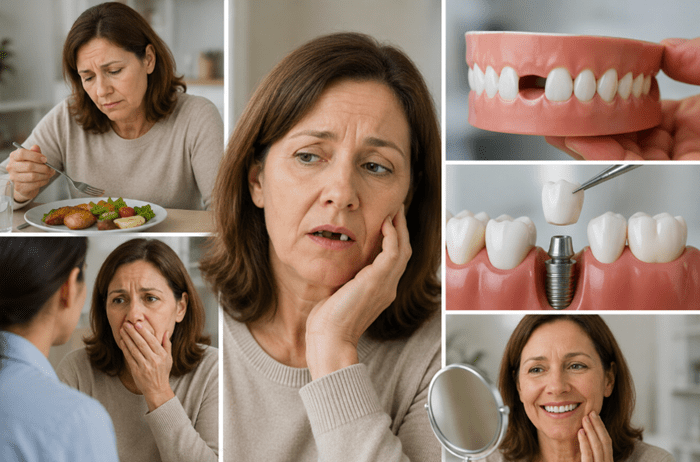
A lost tooth might sound like an inconspicuous problem at first since such an occurrence tends to take place inside your mouth where hardly anyone can see. It’s quite possible for a number of Aussies to leave the gap and continue with their busy lives as normal. Still, losing a tooth might significantly affect your lifestyle and general health status in ways you might not have expected.
Identifying the impact of tooth loss is one of the key steps to overcoming this condition successfully. This article will discuss the most evident challenges, less noticeable consequences, and psychological effects associated with the absence of some teeth. Moreover, the efficient treatment options available will also be discussed here.
Immediate Challenges: Chewing, Pronunciation, and Appearance
The most obvious difficulties arise immediately after losing a tooth. First of all, your ability to chew food gets drastically affected. Crunchy and hard foods become extremely challenging to consume, leaving you no choice but to change your dietary habits completely. As a result, you might have to sacrifice tasty snacks and meals in order to avoid chewing.
In addition to this, pronunciation of certain words becomes difficult for those who lost a tooth. Our tongue and teeth work together while producing sounds required to speak fluently. If there’s a gap between them, you’ll probably develop a speech disorder such as lisp.
Finally, there’s another aspect associated with appearance that needs to be discussed. If there’s a gap in your smile, you’ll certainly try to hide it whenever possible. Thus, talking to friends and family might become a really uncomfortable activity in this case.
Long-Term Effects: Bone Loss and Tooth Migration
In addition to the mentioned problems, there are many others that can be developed due to tooth loss. The main purpose of our jaw bone is to ensure proper functioning of the teeth located inside the mouth. The constant pressure on the bone stimulates its development and growth.
If one of the teeth is missing, the stimulation disappears along with the root. Consequently, this part of the jaw begins to weaken as soon as the problem occurs. Moreover, the absence of any stimulation prevents the bone from remaining healthy and dense enough.
With no support provided by bones, the adjacent teeth become unstable and tend to move to fill in the gap created. As a result, patients find it really hard to clean their mouth properly, thus exposing themselves to high risks of developing serious problems with oral health. In extreme cases, excessive bone loss results in the changed shape of one’s face.
Psychological and Social Impact
It should be noted that the negative effects of tooth loss can extend to a person’s social life and personal health. Those who have gaps in their smile tend to try and hide them at all costs. Hence, smiling and showing their teeth in photographs becomes quite problematic for most people with missing teeth.
In addition to this, people’s self-confidence gets affected greatly because they have no desire to show off their imperfect smile anymore. Visiting friends and going on a date become particularly challenging and uncomfortable tasks.
Consequently, the number of opportunities for socialising reduces dramatically with the emergence of tooth loss.
Treatment Options Available
Fortunately, it’s quite possible to reverse tooth loss and improve a person’s condition significantly. Today’s dentists have plenty of methods that allow replacing missing teeth and protecting the bone tissue.
For example, implants are considered one of the best tools for solving this problem since they mimic the behaviour of a real tooth perfectly. In short, you have a tooth replacement. Due to the fact that implants become integrated with the jawbone, there won’t be any risks of further deterioration. On top of this, bridges and dentures are two other good alternatives to consider. The exact state of your jaw will help to pick the right solution.
Preventing Further Problems
If you notice the absence of a tooth in your mouth, it’s recommended to visit the dentist as soon as possible. This will help you to deal with a problem in its earliest stage and prevent further complications, including complex procedures and huge expenses.